








Our beaches are full of activity in the summer, and in particular from some of our seasonal visitors — the nesting sea turtles. We are fortunate to be a laying ground for several species of sea turtles, including Kemp’s Ridley, Green, Loggerhead, Hawksbill, and Leatherback.
Since 1995, volunteers of the Network for Endangered Sea Turtles, or N.E.S.T., have been patrolling the shores of the Northern Outer Banks — including the Corolla and Carova beaches — to assist hatchlings in reaching the water, to monitor nest health, and to rescue injured or distressed turtles in need. Over the years, N.E.S.T. has assisted more than 700 sea turtles, and their work continues to grow each season.
Sea Turtles of the Northern Outer Banks
Kemps Ridley
One of the smaller species of nesting turtles on the Outer Banks, Kemp’s Ridley is a critically endangered species. Only 7,000–9,000 nesting females are estimated to be in existence today. In the summer of 2023, three nests were found on the beaches of the Outer Banks, which will hopefully assist in this species being around for a long time.
Green Turtle
Green turtles are a larger species and can grow to 3 or 4 feet long and weigh up to 350 pounds. Their population is estimated to be between 85,000–90,000 turtles today, which is still considered a threatened species.
Loggerhead
The Loggerhead is the most common visiting turtle to the Outer Banks. These turtles have large, oversized heads, which lends to the name to crack open some of their favorite hard-shelled crustaceans. Of the sea turtle species nesting in this area, Loggerheads represent the large majority — roughly 75 percent of all nests found in the region each season.
Hawksbill
This critically endangered species traditionally lives in tropical and subtropical climates and does occasionally nest on the beaches of the Outer Banks. The head comes to a pointed shape and their lower jaw is V-shaped, which gives them a hawk-like appearance.
Leatherback
The largest of all sea turtle species, Leatherbacks earned their name from the rubbery texture of their skin. They can’t chew and prefer to eat things like jellyfish as their main diet.
When Does Nesting Season Happen?
Nesting season for sea turtles on the Outer Banks is between May 15 and September 15. Starting around mid-May, adult female turtles will come ashore at night to lay eggs, and once they are done they will return to the ocean. Each nest may contain anywhere from 80 to 100 eggs on average, and the Currituck area may see anywhere between five and ten nests per season — stretching all the way through August.
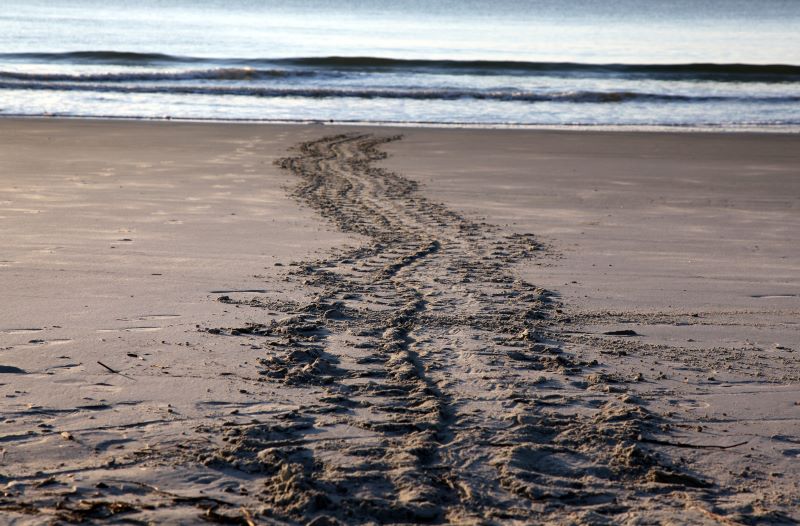
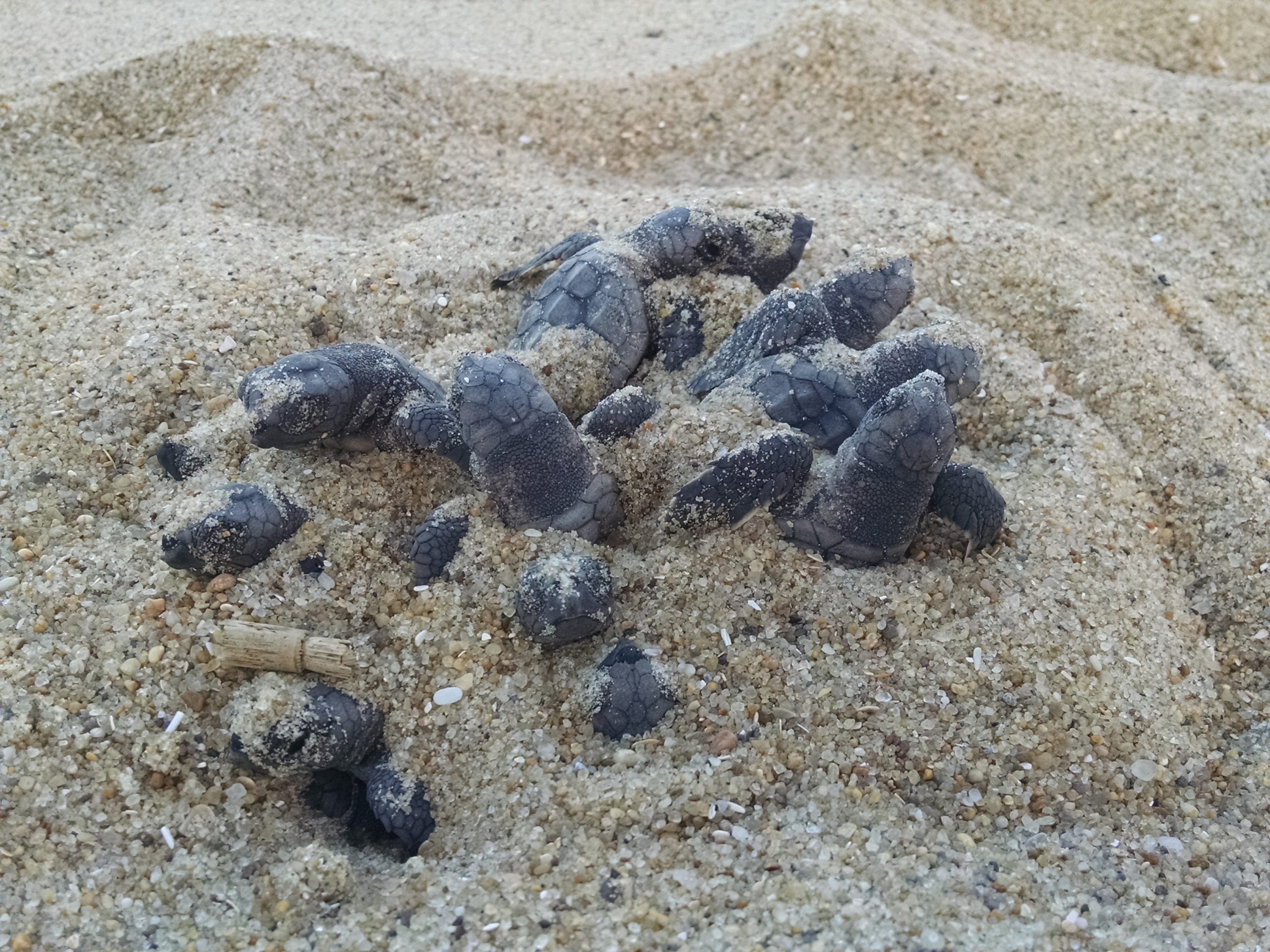
Sea turtle nests hatch between 45 and 70 days after laying, depending on the size of the nest and outdoor temperature and humidity. Baby sea turtles emerge mostly at night and use the light reflected on the ocean to guide them toward the water. One of the most instinctive behaviors to watch for: hatchlings will often follow the smooth, wide tracks left by vehicles on the beach — the parallel lines resemble the light glinting off the ocean surface, acting as a kind of natural guide down to the waves.
Watching a Nest Hatch
Specially trained N.E.S.T. (Network for Endangered Sea Turtles) volunteers check the beach frequently for signs of a nesting sea turtle in order to identify the nesting sea turtle and mark the nest. N.E.S.T. marks the nest and the date of the lay to attempt to know when the eggs will hatch.
As a visitor, these nests are marked with beach fencing, some flags, and occasionally a sign to alert visitors to the active nest beneath the sand. N.E.S.T. continues to observe the nest to wait for the boil — which is when the turtles hatch and begin leaving the nest.
Because sea turtles are protected by the Endangered Species Act, N.E.S.T. does not publicize the exact locations of active nests. If you happen to be on the beach during an emergence, you can watch the hatchlings in action. N.E.S.T. volunteers, identifiable in their bright green t-shirts, will have positions available behind which visitors can observe. N.E.S.T. asks that there be no flash photography or phone lights, as they are trained on the turtles so they are not distracted and wander off in the wrong direction.
How Visitors Can Help Protect Sea Turtles
Visitors can help the nesting sea turtles on the Outer Banks by doing the following:
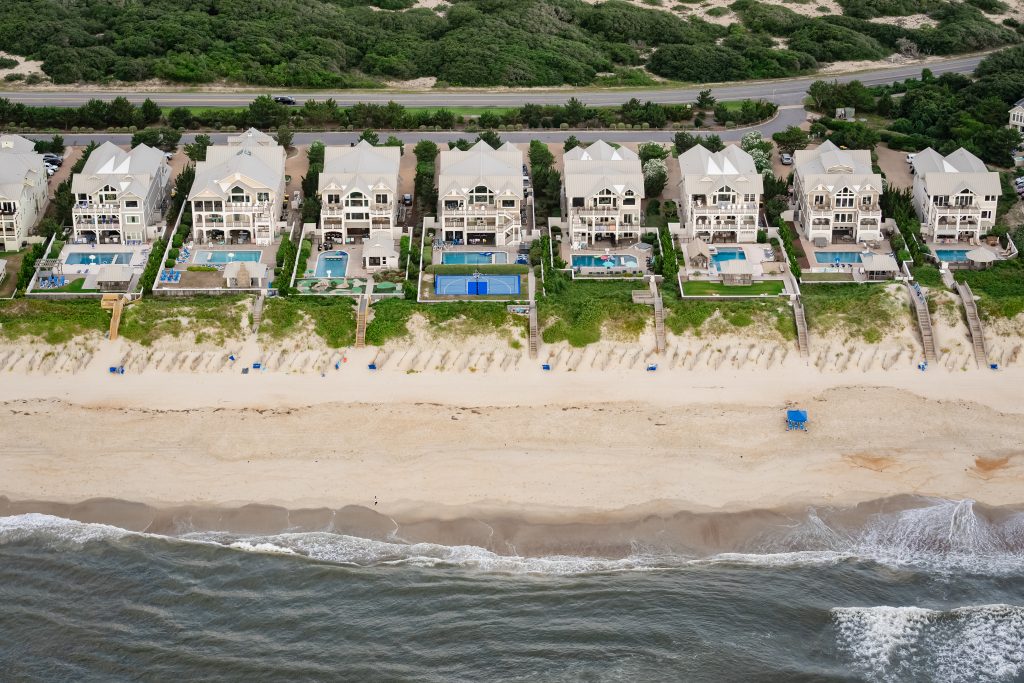
1. Turn off your lights at night. If your vacation rental is located by the beach, N.E.S.T. advises you to turn off all outdoor lights after sundown, and to close blinds and curtains where appropriate to keep indoor lights from shining on the beach. The closer to the beach, the more important this is — additional lights can confuse the nesting sea turtle and the hatchlings.
2. Fill in any deep holes dug on the beach. Holes can hurt the turtles who are roving and searching for nests, and they can also trap the hatchlings and prevent them from getting to the waves for safety. After a day of fun in the sun with your crew, be sure to clean up all trash, beach toys, chairs, tents, and other items you brought to the beach. If you spent the day digging in the sand to make a castle or if you planted an umbrella, fill in all holes before you leave.
3. Keep our beaches clean. Plastic left on the beach can harm adult sea turtles and their young. It is also advised not to leave your “truck” on the beach — leaving your chairs and tents behind for the next day — as adult turtles can get tangled in them.
4. No flash photography or phone lights near nests or hatchlings. Light sources from other places will disrupt the turtles and can put them in harm’s way, guiding them away from the ocean.
5. If you bring your pet to the beach, keep them on a leash to prevent any nest disturbances.
6. Be aware of your surroundings when driving on the beach. The farthest north that sea turtles typically lay their eggs is in Carova, or the northernmost part of the Northern Outer Banks. When traveling on the beach, especially at dusk, evening, or daylight, keep your eyes peeled for nesting sea turtles.
7. If you see a nest boil or hatchlings or a turtle in distress, please contact N.E.S.T. at 252-441-8622. Do not touch! It is illegal to take eggs and hatchlings from a nest. Sea turtles are not pets — and visitors can face fines and jail time if caught and convicted. N.E.S.T.’s 24/7 hotline means a volunteer will come to the rescue.
Why Sea Turtle Season Matters
Sea turtles are an important part of healthy ocean and coastal ecosystems. They help support marine habitats, contribute to the balance of ocean life, and are a meaningful part of the Outer Banks’ natural heritage. Their survival depends on safe nesting beaches, clean water, responsible visitors, and dedicated conservation work.
During sea turtle nesting season, the best way to experience the beach is to leave it clean, dark, flat, and undisturbed. With a little care from everyone, these ancient ocean travelers can continue returning to the Outer Banks for generations to come.
To learn more about the sea turtles on the Outer Banks and the conservation efforts by NEST, click here.