









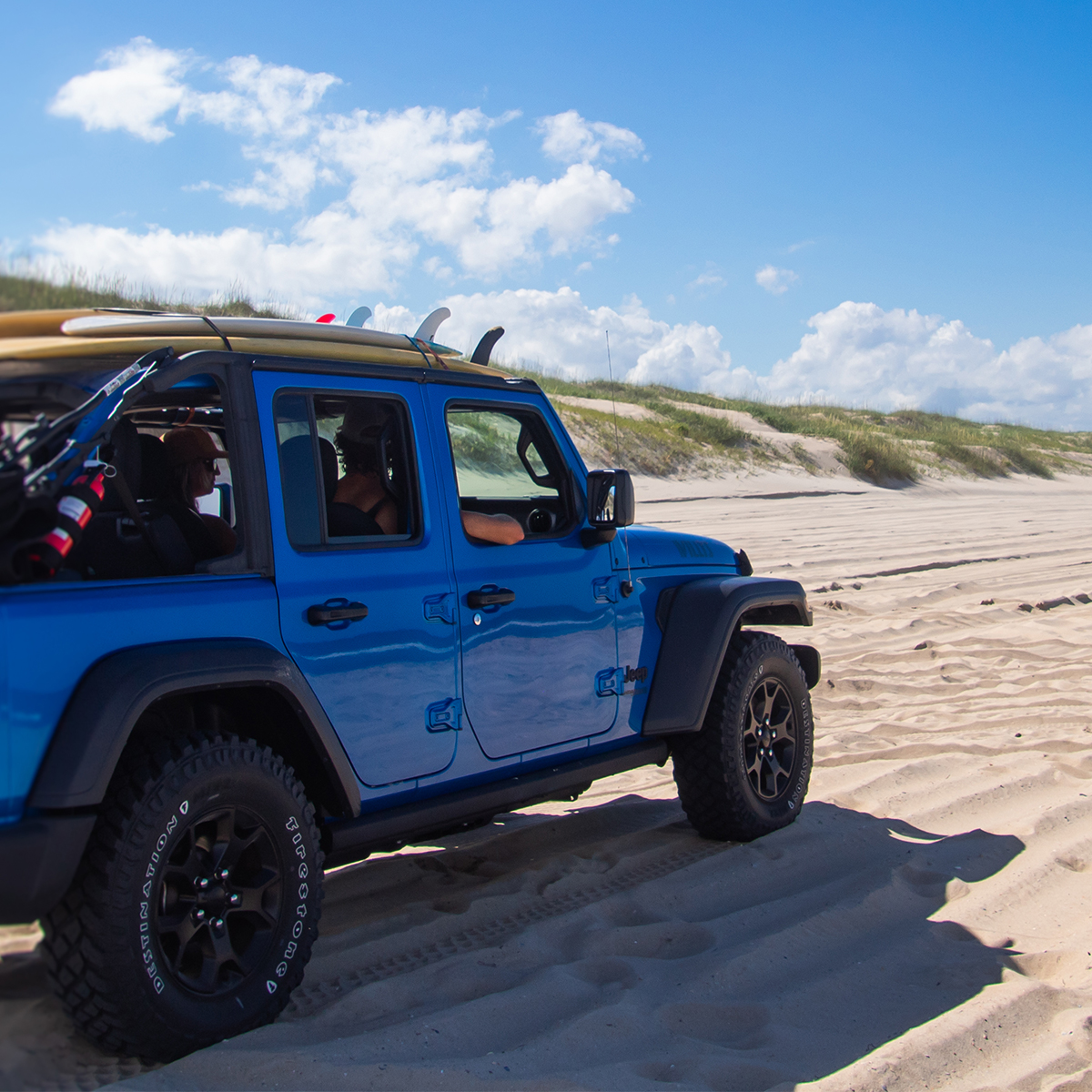
Beach Driving Tips
Driving on The Northern Outer Banks beach — windows down, salty breeze in your hair — is a wonderful thrill, but there are rules and tips you need to know before you head onto the sand. 4WD beach driving is allowed in Carova Beach, the wild horse country north of Corolla, and a permit is required if you plan to park in designated beach parking areas and enjoy some time in the sun between early May and late September. Be sure you know the laws, know how to keep the wild horses safe, and only attempt driving on the sand in a 4WD vehicle.
For a complete list of driving tips and parking permits go to the Currituck County Parking on the Beach Webpage.

Beach Driving Tips & FAQs
Learn more about safe beach driving and find the answers to our most frequently asked questions about The Northern Outer Banks.
Got more questions? Contact Us.
Yes! From the second Saturday in May through the last Saturday in September (2026). All of the parking permit purchasing information is located on the Currituck County website. Please follow this link for details.
- Use a 4WD vehicle and lower tire pressure for better traction.
- Drive slowly and cautiously follow the speed limit.
- Pedestrians always have the right-of-way. Watch closely for children, pets, and wild horses.
- Don’t litter. Remove all trash, bait, and fish remains.
- Watch for traffic patterns on signs.
- For details and more safety tips consult the Currituck County website: https://currituckcountync.gov/beach-parking/
The Corolla 4X4 beach consists of deep, soft sand on the beach strand, and the ramps accessing the sand roads behind the dunes. Soft tires allow for the necessary traction to get through safely.
Air down all tires prior to accessing the off road (4X4) ramp at the air down location (East of Corolla Village Road – Watch for signs directing you).
Recommended tire pressure pounds per square inch (PSI):
- 20 PSI for SUV’s & 1/2 Ton 4X4
- 35 PSI for 3/4 Ton 4X4
Failure to air down sufficiently can place unnecessary stress on your engine and/or create overheating of your transmission fluid, both of which can create a fire.
Failure to air down sufficiently creates ruts and “*wash boarding” in the driving lanes, damaging the beach and sand roads, making travel for others unsafe and very uncomfortable. It is also important to turn off the traction control so the softened tires can do the job they are meant to do without resistance.
You may air up your tires at no charge in Historic Corolla Park.
A Currituck County ordinance went into affect May of 2017 and reads: “No person shall drive a motor vehicle on the beach strand or foreshore with tires containing air pressure exceeding 20 pounds per square inch (p.s.i.).” Violators could receive a citation and a fine.
Please follow this link for more details.
*Wash Boarding: Rivets in the sand similar to a wash board created by tires not aired down properly.
You may take your personal 4WD vehicle onto the beach in the designated driving areas. It is important to note that 2WD and AWD vehicles will not perform on the beaches, and you risk getting stuck. Please be sure to follow all posted speed limits and obey all traffic laws as if you were driving on pavement. Pay close attention as families and other motorists will be present along the shoreline.
No. Only local residents and property owners with the proper permits are authorized to operate an ATV in Currituck County. Please follow this link for more details.
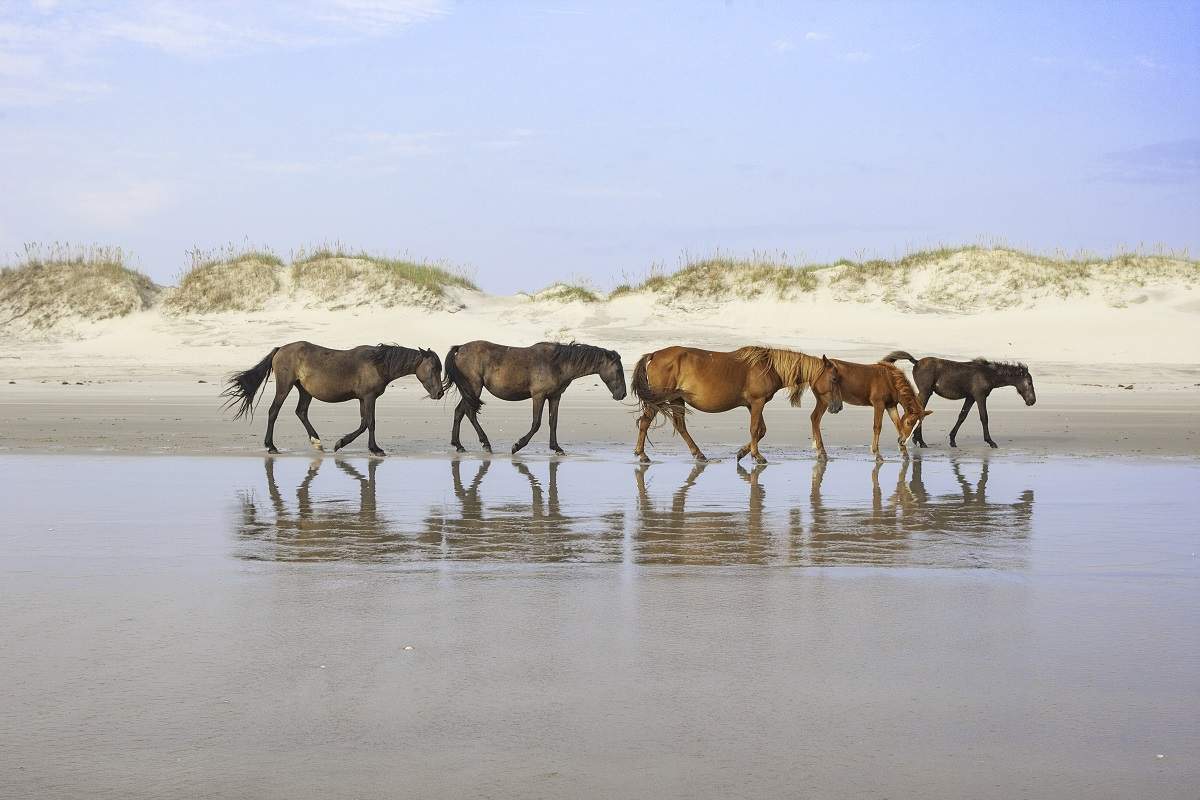
One of the best ways to see the famous Corolla Wild Horses is on a guided off-road tour. These wild horse tours can be booked through an adventure tour company or through the Corolla Wild Horse Fund.
**Please note that it is illegal to intentionally come within 50 feet of the wild horses.
**NEVER feed them. Anything but the natural vegetation found on the beach is toxic to the Banker horses, and too often fatal. This includes not only what we eat but what domestic horses eat as well.
Whether you go see them on your own or with a guided tour, give the horses a wide berth while viewing them. and stay in your vehicle when possible. Harems with a foal are especially vulnerable, so it is best to park a distance away from them or continue past them, especially when there are many people/vehicles around them.
The speed limit is 35 mph. The speed limit is 15 mph when traveling within 300 feet of any person or wildlife.
There are NO gas fueling stations on the 4×4 beaches. Make sure you fill up your tank prior to getting on the 4×4 beach.
Vehicles are required to use driving lanes adjacent to the dune line between Milepost 14.5 and Milepost 17 from 9 AM until 5 PM beginning the Friday before Memorial Day through Labor Day. All other times, use driving lanes adjacent to the dune line or at the shoreline.
No. Do not stop or park for the first 1.5 miles North of the 4X4 Beach Access when coming on to the beach or leaving the beach.
- Use the same caution as if you were driving on a normal road.
- Drive in established tracks whenever possible. If you are traveling in the same lane as an oncoming vehicle, signal with your blinker if you are moving a lane over. Whenever possible stay to the right of oncoming vehicles and pass vehicles on the left.
- Driving lanes vary with tide changes. Please follow posted driving patterns requested by law enforcement and the diagram on the ParkingOnTheBeach.com website. This may change based on the tide, but all patterns will either follow the shore line (foreshore) or at the dune line.
- Please park your vehicle in the middle of the beach strand allowing for adequate room for driving at the dune line and at the shore line (foreshore). This is for access for travelers as well as for beach safety vehicles and law enforcement.
No. Not only is the salt water extremely corrosive, if its under the hood it can cause the vehicle to stall or shut down completely.
Also it is very unsafe not knowing if someone is in the water where you are driving.
Your vehicle could be lost to the sea. Not only a financial nightmare but also unsafe for the environment.
When driving behind the dunes, look for traffic both ways before proceeding through intersections.
The sand roads behind the dunes flood after significant rain, including some thunderstorms. Use extreme caution when driving through flooded areas; proceed slowly through standing water to avoid sandy water on your vehicle and to prevent damaging the roads by creating ruts and holes. If you cannot see the sand below the water, best to find another route to your destination.
Please honor no trespassing signs on private property. This includes residence as well as undeveloped lots.
Sea turtle nesting activity is from May through September. Use caution when driving on the beach, especially at night when most Outer Banks turtles nest. Report any activity to NEST (Network for Endangered Sea Turtles) hotline at 252-441-8622.
Tide cycles occur twice daily and are around six hours apart from high to low. Tides are lunar driven and may be higher during the high tide cycle when the moon is full. In addition, stronger northeast winds will increase the tide level. Driving on the beach when the tide is low is easier on your vehicle and provides a more comfortable ride. Tide charts are available at various locations in Corolla or you can add a tide app to your phone that will show tide levels and times.
No. Only designated access ramps and walking paths.
The dunes provide a natural barrier for protection against hurricanes and northeasters. As you can imagine, the dunes are very fragile. While dune vegetation such as sea oats and American beach grass provides the most effective stabilization, wind and tides can eat away at the dunes. Fortunately, some sand is replenished over time with shifting winds.
Driving on, walking, climbing or sliding down the dunes not only breaks down the dune, but damages the vegetation and the root system that provides stabilization. This can prove to be even more damaging to the dune structure than the storms themselves. Please stay on designated pathways and ramps for walking across the dunes and never drive on them.
No beach chairs, coolers, fishing lines, or other items should be placed in a location that blocks the traffic lanes. This includes the shoreline (foreshore). This may involve moving vehicles and belongings with the tide change.
Visitors should not leave any unattended property on the beach. Any property remaining between sunset and sunrise shall be considered litter and is subject to removal and disposal.
Help keep the Northern Outer Banks beautiful for everyone by removing all trash when you leave.